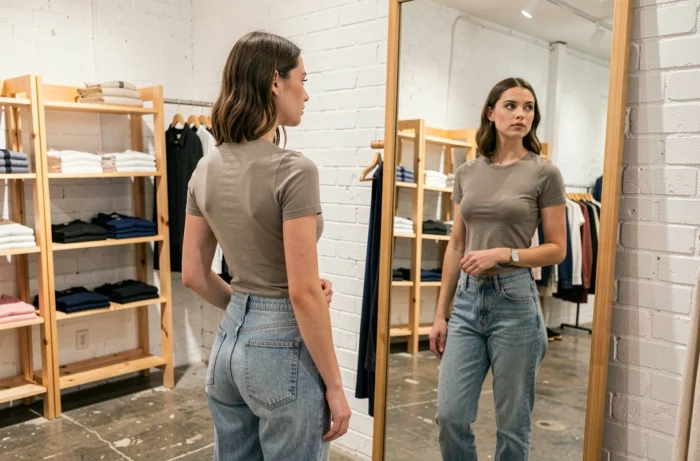
The word “top” refers to any upper garment covering the bust, from tank tops to blouses to t-shirts. The term “crop top,” on the other hand, does not describe a different style of clothing, but a length: that of a top whose hem stops at the waist or above.
Confusing the two means mixing a general category with one of its variants. This ambiguity persists because brands use these terms interchangeably in their product descriptions.
Why the boxy cut blurs the line between top and crop top
The boxy silhouette, straighter and wider at the shoulders, has become prominent in streetwear and activewear offerings. A boxy t-shirt falling just above the waistband of high-waisted pants can look like a classic top when worn, even though it is technically cut short.
This phenomenon complicates label reading. A garment labeled “top” in one store may stop at the same height as a “crop top” from another brand. The only reliable criterion remains the position of the hem in relation to the natural waist, not the brand name.
To clearly distinguish between top and crop top, one must observe where the fabric stops on the body rather than rely on the manufacturer’s description. A classic top falls to the hips, sometimes down to the mid-thigh for tunic styles. A crop top, regardless of its shape, reveals a band of skin or overlaps with high-waisted bottoms without excess fabric.
Crop top worn year-round: how layering changes the definition
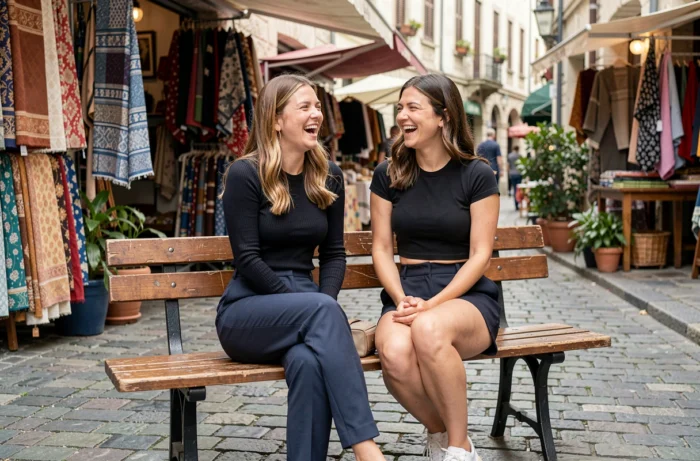
Associating the crop top with summer or festivals no longer reflects the reality of the market. Analyses of textile offerings in 2026 describe a piece worn across four seasons, integrated into layered outfits. Under a jacket, an open cardigan, or an oversized shirt, the crop top becomes a layering element whose short length is only partially visible.
This evolution has a direct consequence on terminological confusion. When a crop top is worn under a blazer with high-waisted pants, the visible skin can be almost nonexistent. The criterion of “visible belly” no longer works to distinguish the two categories.
Length as the only common denominator
The term “crop” literally means “shortened.” It applies to any top, not just fitted tank tops. Today, there are crop sweatshirts, crop shirts, crop cardigans, and even crop blazers. Crop describes a length, not a shape or style.
A classic top and a crop top can therefore share exactly the same material (cotton, polyester, ribbed knit), the same sleeves (short, long, sleeveless), and the same neckline (round, V-neck, high). The only variable is the hem.
Body type and size: how to choose between classic top and crop top
The choice between a standard top and its crop version depends less on the silhouette than on what is worn on the bottom. Here are the combinations that work best:
- Crop top with high-waisted pants or skirt: the hem of the top meets the waistband of the bottom, keeping proportions balanced without exposing the belly
- Classic top tucked into normal-waisted bottoms: similar effect to the crop top, but with excess fabric to manage under the waistband
- Boxy crop top with straight jeans: the wide cut of the top balances the narrowness of the bottom, creating a relaxed effect suitable for streetwear
- Long top or tunic with leggings or skinny jeans: the length of the top covers the hips, which is suitable for more formal contexts or sports
The crop top does not require a specific body type. Wearing it with high-waisted bottoms allows for adjusting the amount of visible skin according to individual comfort. Field feedback varies on this point: some brands continue to present the crop top as a garment reserved for slender silhouettes, which does not reflect the diversity of the current offering.
Fabrics and care: the same materials, different constraints
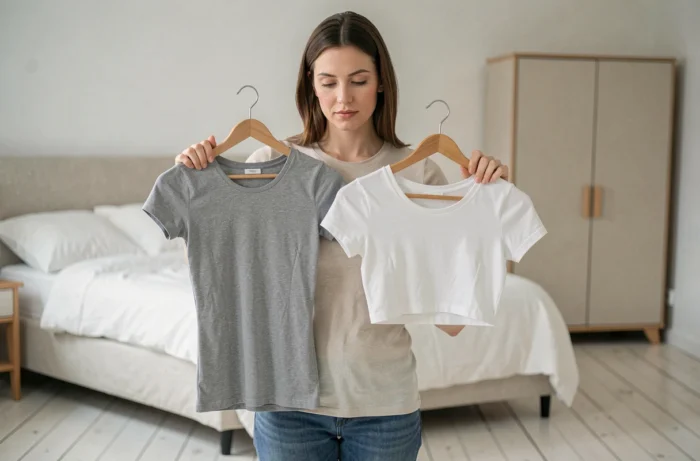
A cotton crop top is washed and ironed exactly like a classic cotton t-shirt. The material does not change with the length. However, crop tops intended for sports often use synthetic blends (polyester, elastane) designed for moisture-wicking, which requires washing at low temperatures and air drying.
For classic tops, the variety of materials is broader: there are linen, silk, viscose, thick cotton like sweatshirt fabric. The choice of material depends on the context of use, not the length of the garment.
A point of caution about fine cotton
Crop tops made of fine cotton or lightweight jersey tend to ride up throughout the day, especially with a fitted cut. A sufficiently dense weight limits this issue. Ribbed knit models hold their position better due to the texture that slightly grips the skin.
Complete outfit: pairing top and crop top in the same look
An approach that has developed is to wear a crop top over a longer top, creating a visible play of lengths at the hem. This layering works particularly well with a wide crop sweatshirt over a fitted t-shirt, or an open crop cardigan over a standard tank top.
The top and the crop top are not alternatives, but complementary pieces in a wardrobe. Opposing them is like asking whether to choose between pants and shorts: the answer depends on the context, the weather, and the desired outfit.
The distinction boils down to a single technical parameter, the length of the hem in relation to the natural waist. Everything else (cut, material, sleeves, neckline, style) can be identical. Keeping this criterion in mind simplifies online shopping, where photos do not always suffice to differentiate between the two terms.