The leisure activities of the French do not follow a uniform trajectory. Some activities are slightly declining compared to 2024, others are holding steady, and the gaps between major urban centers and less dense areas remain significant.
Spending one’s free time is therefore not just about picking from a generic list: the place of residence, the format of the activity, and real barriers (availability, crowds, budget) influence choices much more than one might think.
Barriers to leisure: what the 2025 barometer changes in the approach
The 2025 barometer identifies three main obstacles to participation in cultural and leisure events: lack of availability, perceived lack of interest, and fear of crowds. Budget does not top the list, a finding that shifts attention towards barriers that are more organizational than financial.
This hierarchy of barriers has a direct practical consequence. Looking for original ideas for free time benefits from prioritizing three criteria: short formats that do not require blocking off half a day, activities without mandatory reservations, and time slots that are offset from peak attendance. By browsing the MaxiScoop site to discover activities categorized by type of leisure, one quickly spots options that tick these boxes without straining an already busy schedule.

Creative activities at home: beyond classic DIY
Cooking remains the most cited domestic leisure activity in French surveys, and for good reason: it combines learning, immediate results, and a social dimension when sharing a meal. Trying out a recipe from a foreign cuisine on a weekday evening requires neither registration nor special equipment.
Other creative practices are gaining ground without requiring a heavy investment:
- Building models or 3D wooden puzzles, which offers a hands-on activity disconnected from screens, suitable for both adults and children.
- Short writing (short stories, journals, micro-fictions), which only requires a notebook or a word processor and can be practiced in twenty-minute segments.
- Online drawing or watercolor classes, often free on video platforms, which allow for progress at one’s own pace without time constraints.
The common point of these activities: they operate in short sessions, directly addressing the availability barrier identified by the barometer. There is no need to free up an entire afternoon to get started.
Outdoor leisure and cultural outings: adapting choices to place of residence
The 2025 barometer describes cultural practices as more frequent in major urban centers than in urban fringes and rural municipalities. Cinema, concerts, and libraries account for most of this gap. Recommending a museum visit or a live concert as an “easy” activity ignores the fact that access to cultural leisure heavily depends on geography.
For residents of less equipped areas, other formats deserve attention. Youth and cultural centers (MJC) offer a range that combines cultural practices, sports, and varied learning opportunities. The MJC Observatory published in 2026 (based on 2024 data) confirms that these structures welcome all ages, not just young people. Theater workshops, team sports classes, supervised board game sessions: the range exceeds what their name suggests.
Outdoor sports remain a reliable option for occupying free time without relying on heavy infrastructure. Walking, running, and cycling require neither registration nor fixed time slots. To vary, mobile apps offer discovery routes that turn a simple walk into an exploration game, alone or with friends.
Learning online: free courses and enduring formats
Online learning is among the leisure activities that have progressed the most in recent years. Foreign languages, programming, art history, guided reading: free online course platforms now cover almost all fields.
The classic trap remains enthusiastic registration followed by abandonment after two weeks. To circumvent this pattern, it’s better to target short formats: modules of five to fifteen minutes a day yield more consistent results than a one-hour lecture that one ends up postponing. Educational podcasts also serve this role, as they can fit into a commute or a break without requiring dedicated time.
Educational or narrative video games represent another often underestimated avenue. Some strategy or management titles develop problem-solving skills while providing real entertainment. Playing does not exclude learning, as long as one chooses games that stimulate thought rather than mere reflex.
Activities with friends or family: ideas that break the usual mold
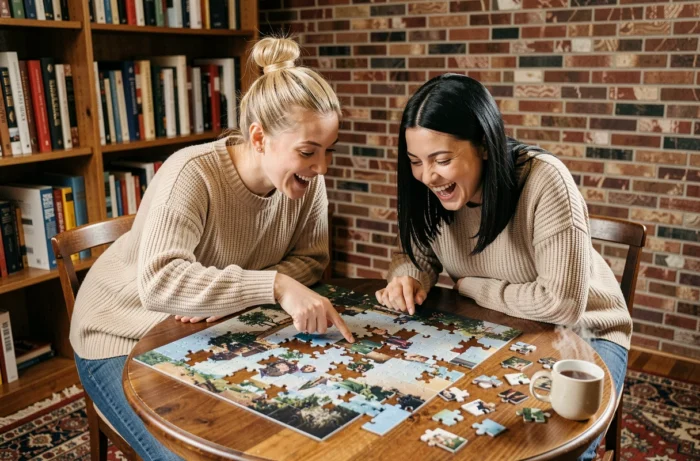
Beyond classic Monopoly, cooperative or investigative games completely renew the experience of game nights and are suitable for both children and adults.
Organizing a monthly cooking club among friends, where each participant prepares a dish from a different country, transforms an ordinary meal into a full-fledged activity. The cost remains modest, the logistics light, and the monthly format avoids monotony.
At-home escape games (printable kits or dedicated apps) offer an alternative to outings in venues, without the constraints of reservations or travel. A session typically lasts an hour, making it a format compatible with a busy schedule.
Activities that endure are those that adapt to real constraints: available duration, proximity, momentary desire. Starting from these three parameters, rather than a fixed list, remains the most reliable way to find a leisure activity that one truly engages in.