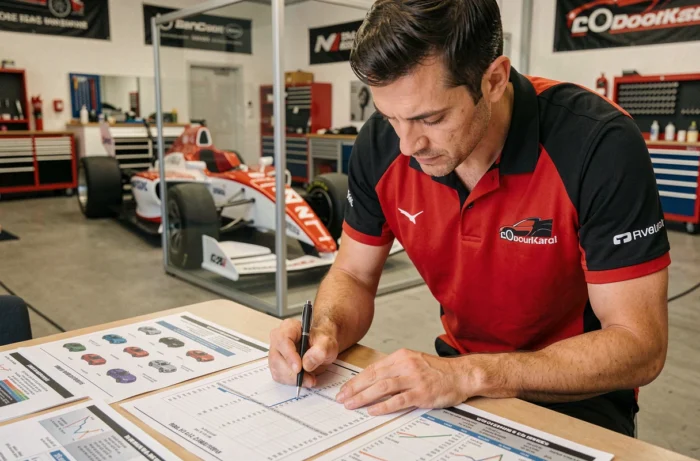
Buying a race car is not like buying a used sedan. The vehicle is not road-legal, the technical criteria change depending on the discipline, and a detail on a homologation sheet can deny you access to a grid. Before browsing the listings, you need to know exactly what you are looking for, and especially what the regulations allow.
Sporting eligibility and homologation sheet: the filter that no one checks first
You’ve spotted a car advertised as “race-ready.” The price is right, the photos are flattering. Why not take the plunge right away?
Because a race-ready car may not be suitable for your category. The FIA period and the homologation sheet determine the grids that the vehicle can access. An non-compliant modification leads to a failure at the technical sports inspection, even if the car runs perfectly.
For historic vehicles, the historic technical passport (PTH) describes compliance with a competition configuration. It does not certify the authenticity of the vehicle’s history. These are two distinct checks, and confusing the two can be costly.
In practical terms, before comparing prices, identify the targeted discipline (rally, circuit, hill climb) and check that the vehicle complies with the regulations of the championship or grid you are aiming for. This step easily filters out half of the listings that do not concern you, and this is precisely what the Mikado Racing guide on WD Car allows you to do by detailing the selection criteria suitable for each driver profile.

Outdated safety equipment: the hidden cost after purchase
A seller advertises an operational vehicle with harnesses, buckets, and a fire extinguisher. On paper, everything is there. In practice, each safety equipment has an expiration date.
Harnesses generally expire a few years after their manufacture. Fire extinguishers have a service deadline. Safety tanks do too. If any of these elements are expired, you will not be able to race until they are replaced.
Here are the points to systematically check before signing:
- The manufacture and expiration date of the harnesses, which is found on the label sewn to the strap. An out-of-date harness means an immediate replacement is necessary.
- The validity of the onboard fire extinguisher, often overlooked during private sales. An expired extinguisher will be refused during technical checks before the race.
- The condition and compliance of the safety tank (FT3 tank or equivalent), whose replacement represents a significant budget item.
- The homologation date of the bucket, as some older models no longer meet current standards in today’s championships.
A vehicle advertised as operational may require several hundred euros to bring it up to compliance before the first run. Always ask the seller for the dates. If they are not listed in the ad, ask the question before you go to see it.
Circuit insurance and liability: two distinct coverages to understand
Have you ever noticed the mention “insurance included” on some track events? This wording can be confusing.
The liability insurance taken out by the event organizer protects third parties. It does not cover damages to your own vehicle. Your car’s coverage depends on your personal contract and the type of driving (open track day, homologated competition, private training).
A car reserved for the circuit does not need to be registered. However, it must be transported by trailer to the event location. This logistical constraint weighs on the annual budget: cost of the trailer, towing vehicle, storage between races.
If you are just starting out and your budget is tight, factor in the logistical costs in your calculations before choosing the vehicle. A cheaper car to buy but that requires a specific trailer for transport can end up costing more over a season than a slightly more expensive model that is easier to move.

Concrete selection criteria based on your level and discipline
Why this choice over another? Because the ideal vehicle depends on three interacting parameters: your driving experience, the targeted discipline, and your overall annual budget (not just the purchase price).
Rally or circuit: two different mechanical logics
A rally vehicle endures very different suspension and transmission stresses than a circuit car. The wear parts are not the same, nor are the maintenance intervals. Choosing a “versatile” vehicle to do both often results in doing both poorly.
Beginner level or experienced driver
A driver starting in competition does not need a very powerful car. A modest and well-prepared machine allows for faster progress than a powerful vehicle that is difficult to control. Promotional formulas (monotype cups, for example) offer identical cars for all competitors, which reduces preparation costs and emphasizes driving skills.
Realistic annual budget
The purchase price rarely represents more than half of a season’s budget. Recurring expenses include:
- Tires, the first consumable expense on the circuit, whose cost varies significantly depending on the category and the number of planned track days.
- Mechanical maintenance between each event (brakes, fluids, chassis checks).
- Entry fees for events or track days, which can accumulate quickly over a full season.
- Transportation and storage of the vehicle, often underestimated by first-time buyers.
Before searching for the car, set a total annual budget. Then subtract the recurring expenses. The remaining amount is your realistic purchase envelope. Starting from the overall budget avoids unpleasant surprises during the season.
The choice of a race car relies less on a crush than on the compatibility between a sporting regulation, a realistic budget, and a driving level. Checking eligibility, verifying the validity dates of safety equipment, and anticipating logistical costs are three reflexes that separate a successful purchase from a season that falters right from the first event.