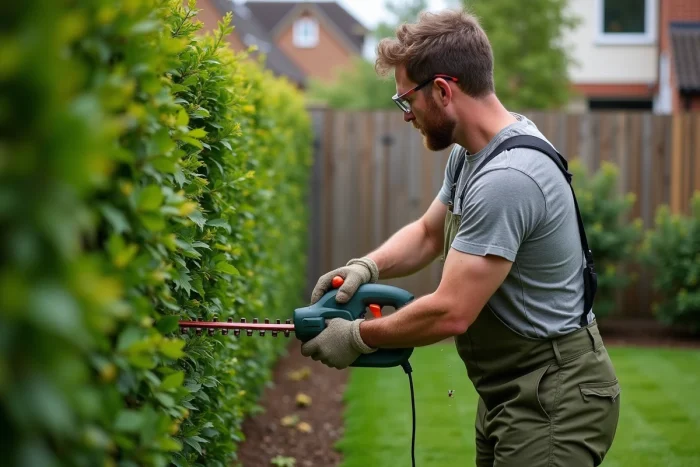
A hedge of privet that exceeds the fencing in the middle of summer, laurel branches encroaching on the sidewalk after three weeks without maintenance: we all know this situation where the electric hedge trimmer makes the difference between a well-kept garden and a thicket. Choosing the right model starts with understanding what we will actually ask of it, not just lining up technical specifications.
Battery Ecosystem: The Criterion That Matters Before the Blade
We often start by comparing blade length or power. In practice, the first purchasing filter for a cordless hedge trimmer has become compatibility with the batteries we already own. If you have a Bosch, Ryobi, or Stihl lawn mower or blower, staying within the same battery ecosystem reduces the overall cost and simplifies storage.
A good capacity battery often represents about a third of the tool’s price. Buying a hedge trimmer from a different brand requires investing in an additional charger and battery. We compare compatible ranges between tools from the same manufacturer on taille-haie-electrique.com, which helps to calculate the real cost of a new acquisition rather than just the displayed price of the unit alone.
This reasoning is especially true for cordless models. If your garden has an outdoor outlet within twenty meters of the hedge, a corded hedge trimmer remains a relevant option: no autonomy limits, reduced weight, and a significantly lower entry budget.
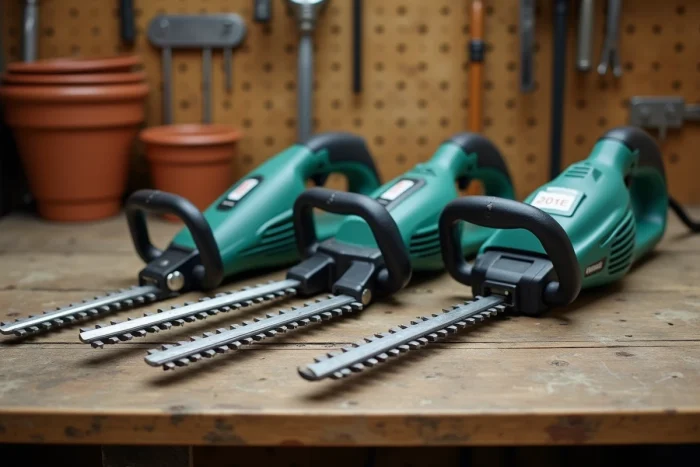
Blade Length and Tooth Spacing: Adapting the Tool to the Hedge, Not the Other Way Around
We regularly see individuals buying a model with a long blade to “go faster.” On a narrow hedge of regularly trimmed thuja, a blade that is too long becomes cumbersome and makes vertical cuts imprecise.
What Blade Length for What Type of Hedge
For a low and thin hedge, maintained several times a year, a short blade (around 45 cm) offers better maneuverability. Longer or taller hedges justify a blade of 50 to 60 cm, which covers more surface area in one pass.
The spacing between the teeth determines the diameter of branches that the tool can cut cleanly. A tight spacing is suitable for the tender shoots of a regularly maintained hedge. A wider spacing accommodates thicker branches, typical of a wild hedge or a vigorous laurel that is only trimmed twice a year.
- Buxus, privet, or hornbeam hedge trimmed every month: short blade, reduced tooth spacing, lightweight model
- Mixed hedge (laurel, photinia) trimmed two to three times per season: medium blade, intermediate spacing
- Wild or old hedge with woody branches: long blade, wide spacing, higher power
Starting from the existing vegetation avoids ending up with a tool that gets stuck on the slightest semi-woody branch, or conversely, an oversized model that is difficult to handle at height.
Weight, Balance, and Noise Level: What You Feel After Thirty Minutes of Cutting
Technical data provides the gross weight. What it doesn’t convey is how the device performs after half an hour of holding it at arm’s length, especially during a vertical cut along a shared wall.
Ergonomics and Rotating Handle
A rotating handle radically changes comfort during lateral and high cuts. Instead of twisting the wrist to follow the hedge’s profile, you adjust the angle of the handle. This detail, absent from entry-level models, makes a real difference when the hedge exceeds shoulder height.
Balance is just as important as total weight. A well-balanced hedge trimmer that is a few hundred grams heavier than a poorly distributed competitor will tire the arms less. Feedback on this point varies according to body types, but you can test the grip in-store by simulating a vertical cut for about thirty seconds.
Noise in Residential Areas
In a housing estate or city garden, noise level becomes a selection criterion as crucial as power. Electric models (corded and battery-operated) are significantly quieter than gas-powered ones. Among electric models, differences remain noticeable from one to another.
Municipal regulations often limit the hours for motorized gardening on weekends. Choosing a quieter device expands the usable time window without neighborhood conflict, a practical advantage that is often underestimated at the time of purchase.

Blade Maintenance and Safety: Two Minutes After Each Use
An electric hedge trimmer requires little maintenance, but the blade remains a cutting component that dulls. After each session, wipe both sides with a cloth to remove sap and plant debris. A light coat of lubricant (petroleum oil or specific spray) prevents oxidation and maintains cutting fluidity.
Cleaning the blade after each use extends its lifespan by several seasons. When the teeth start to crush branches instead of cutting them cleanly, it’s a sign that sharpening or replacement is necessary.
- Unplug the device (or remove the battery) before any blade handling
- Wipe off sap and apply a light lubricant on both sides
- Check the condition of the teeth and the tightness of the protective cover before each use
- Store the tool in a dry place, with the blade protected by a sheath if provided
On the safety side, wearing thick gloves, protective glasses, and fitted clothing (no loose sleeves) is essential. With a corded model, keep the cable behind you and always work away from the outlet.
The electric hedge trimmer suited to your garden is not necessarily the most powerful or the most expensive. It’s the one whose blade matches your vegetation, whose weight remains manageable throughout the cutting duration, and whose battery integrates with the tools you already use. A thoughtful purchase on these three points avoids disappointments in the second season’s pass.