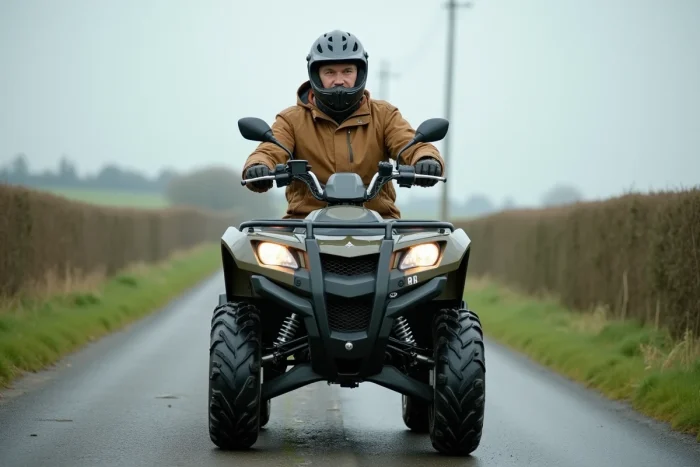
An agricultural operator who wants to connect a plot a few kilometers from their farm with their T3b quad, a landscaper crossing a village to access a forestry site: these situations raise a specific question. The homologated T3b quad travels on the road, but not under the same conditions as a classic heavy quadricycle L7e. The T3b category corresponds to an agricultural vehicle, and this classification changes everything, from the required license to insurance and technical control.
T3b Homologation: What the Registration Document Implies Daily
Field J.1 of the registration document for a T3b quad indicates the type “tractor” (TRA), not “motor quadricycle” (QM). This distinction is not administrative: it determines the legal framework for circulation. A T3b is approved as an agricultural or forestry vehicle, which means that its primary use must remain related to agricultural or forestry work.
Today, many models are offered with dual homologation L7e/T3b, such as the CFMOTO CFORCE 1000 or the TGB Blade 1000. The choice between the two statuses is made at the time of purchase, and the consequences are direct on taxation, insurance, and control obligations.
The T3b homologation entitles operators and certain companies to a recoverable VAT on the purchase and a reduced registration fee. These financial advantages explain why some individuals are sometimes tempted by the T3b status, even without actual agricultural activity. You can find the details of the conditions for driving a T3b quad on the road with Automobile Référence, particularly regarding accepted licenses and required equipment.
License and Minimum Age to Drive a T3b Quad
Confusion is common because the rules differ depending on whether the quad is linked to an agricultural operation or not.
- A 16-year-old driver can operate a T3b quad if it is linked to an agricultural operation, an ETA (agricultural work company), or a CUMA (cooperative for the use of agricultural equipment). No B license is required in this case, but the driver must be able to justify the link with the operation.
- Outside of this agricultural framework, a B license and a minimum age of 18 are mandatory to drive a T3b on public roads.
- The maximum speed of the T3b is limited according to the vehicle’s approval, usually to 40 km/h. A speed limit sign must be visible at the rear.
Wearing a helmet is recommended by the MSA (Agricultural Social Mutuality) for agricultural T3bs, but it is not always mandatory as it is for an L7e. Feedback varies on this point depending on the prefectures, and in practice, some insurers impose it in their general conditions.
Insurance and Risk of Reclassification of a T3b Quad
The insurance for a T3b quad generally costs less than that for an L7e, because the vehicle is classified as an agricultural machine with a limited speed. The problem arises when the actual use no longer corresponds to the declared purpose.
A T3b used almost exclusively for commuting or leisure rides may be subject to a reclassification of risk by the insurer. In the event of a claim, if the investigation reveals a diverted use, coverage may be denied. This is not theoretical: there are cases of denied compensation when the T3b quad is clearly not used for agricultural purposes.
For mixed use (some road trips between plots, plus field use on the operation), most insurers accept the contract without difficulty. The key remains the consistency between the vehicle’s status and its declared use.
Technical Control and Mandatory Equipment on the Road
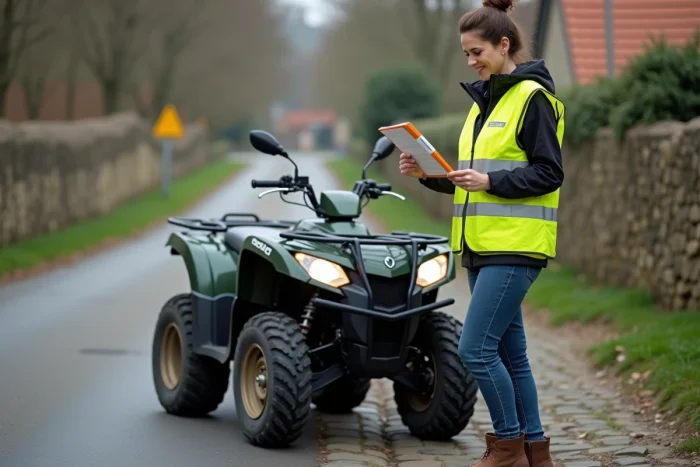
Since April 15, 2024, the obligation for periodic technical control applies to quads registered in categories L (L6e, L7e). T3b quads, approved as agricultural machines, remain exempt from road technical control provided their use complies with their designated purpose.
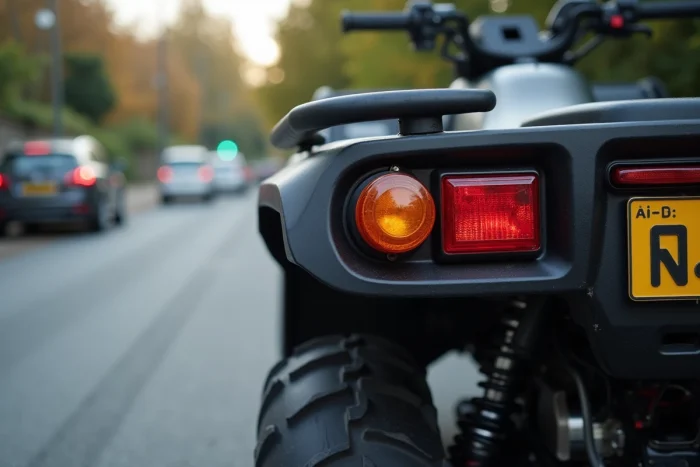
This exemption does not relieve the requirement for signaling equipment to circulate on public roads. A T3b quad authorized to drive on the road must have certain elements.
- An illuminated operating or registration plate at the rear
- A functional brake light and, depending on the models, one or two mirrors
- A visible speed limit sign corresponding to the maximum approved speed
- A beacon is recommended (not mandatory but strongly advised by the MSA for visibility)
The T3b quad is limited to a single seat unless otherwise stated on the registration document. Transporting a passenger on a single-seat T3b constitutes an offense.
L7e or T3b: The Choice to Make Before Purchase
Choosing a T3b for tax opportunism without having actual agricultural activity exposes one to complications in case of control or claim. The L7e status allows unrestricted road circulation, accepts standard technical control, and simplifies the relationship with the insurer. The T3b remains relevant only for professional agricultural or forestry use with occasional road trips between plots or to the operation.
The parallel ranges offered by manufacturers facilitate the choice: the same model often exists in both L7e and T3b versions, with identical mechanical characteristics but different administrative frameworks. The decision is made at registration, and changing status later requires a new vehicle approval.