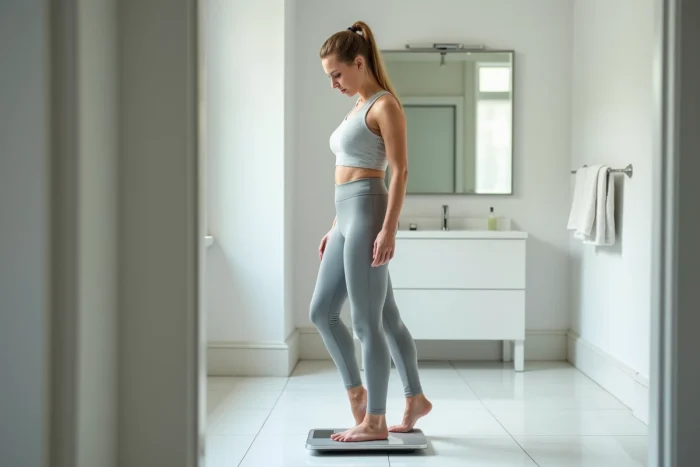
A woman who is 1.65m tall and steps on the scale often seeks a specific number. Determining the ideal weight for a woman who is 1.65m tall requires understanding what the available tools really measure, and especially what they do not measure.
Why ideal weight formulas do not target your silhouette
You have probably come across the names Lorentz, Devine, or Creff in articles on the subject. These formulas yield different results for the same height, which creates confusion. The reason is simple: these formulas were not designed to define a weight loss goal.
Many of these equations were developed in a medical context, particularly for adjusting medication dosages in anesthesia or pharmacology. When applied to the general public, they produce approximate benchmarks that ignore actual body composition.
To delve deeper into the ideal weight for a woman measuring 1.65m, one must move beyond these historical calculations and look at what medicine recommends today.
The result varies depending on the formula chosen. Lorentz yields one number, Creff another, and Devine a third. This dispersion proves that none of these equations holds the truth. They provide an indication, not a prescription.

BMI and healthy weight range for 1.65m: reading the right benchmarks
The body mass index remains the most commonly used tool by health professionals. It divides weight (in kg) by height (in meters) squared. For a woman who is 1.65m tall, the normal weight range corresponds to a BMI between 18.5 and 25.
In practical terms, this represents quite a wide range. The word “ideal” suggests that there is a fixed point. BMI says otherwise: it defines a zone, not a number.
What BMI does not capture
BMI does not distinguish between muscle mass and fat mass. A woman who engages in weight training may have a BMI of 26 while having a low body fat percentage. Conversely, a sedentary woman with a BMI of 22 may have excess visceral fat.
Waist circumference complements BMI to assess metabolic risk. A waist circumference above a certain threshold indicates an increased cardiovascular risk, even if BMI remains within the normal range. This second indicator is too often overlooked in online calculators.
Ideal weight by age: a variable often missing from charts
The majority of ideal weight charts do not take age into account. Recent data shows that the recommended BMI range increases with age.
For those aged 19-24, the favorable BMI range is between 19 and 24. It rises to 23-28 for those aged 55-64, and then to 24-29 after 65. Translated into concrete terms: a 25-year-old woman who is 1.65m tall and a 60-year-old woman do not have the same weight target.
This evolution can be explained by well-documented physiological mechanisms:
- Muscle mass naturally decreases after age 30, altering the muscle/fat ratio even at stable weight.
- Fat reserves play a protective role after age 65, with a slightly higher BMI being associated with better resistance to diseases.
- Hormonal fluctuations related to menopause redistribute fat to the abdominal area, changing the silhouette without necessarily altering total weight.
Aiming for the same number at 25 and at 60 makes no medical sense. The weight goal must evolve with life.
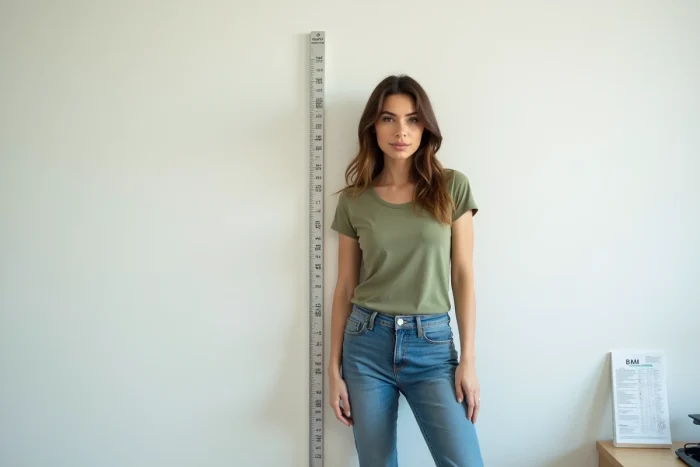
Body type and bone structure: adjusting the slider to your body
Two women who are 1.65m tall can have very different builds. One has thin wrists and narrow shoulders. The other has a broad frame and pronounced hips. Giving them the same target weight would be like imposing the same clothing on them.
The Creff formula incorporates body type by distinguishing three types: thin, normal, and broad. This is an improvement over formulas that only consider height. The Monnerot-Dumaine formula uses wrist circumference to estimate bone structure.
How to assess your body type
A quick test involves wrapping your thumb and middle finger around your opposite wrist:
- If your fingers overlap, you have a thin bone structure.
- If your fingers just touch, your bone structure is average.
- If your fingers do not touch, you have a broad bone structure.
This test does not replace a medical evaluation. It provides a first benchmark to understand why a comfortable weight for a thin bone structure is not suitable for a broad bone structure, and vice versa.
Looking beyond the number on the scale: the indicators that matter
Weight alone is a poor indicator. A nutritionist assesses healthy weight by cross-referencing several data points: BMI, waist circumference, body fat percentage, weight history, and lifestyle habits.
The concept of “ideal weight” also deserves mention. It is the weight at which the body naturally stabilizes without dietary restrictions. It fluctuates by a few kilos depending on the seasons and hormonal cycles. Trying to drop below this threshold through strict dieting often leads to a rebound effect.
Rather than aiming for a specific number, a more reliable approach is to observe how you feel physically, your daily energy levels, and your blood test results. A healthy weight is also measured by what the body allows you to do, not just by what the scale shows.
For a woman who is 1.65m tall, the reasonable range varies according to age, body type, and level of physical activity. Consulting a doctor or nutritionist remains the safest way to obtain a personalized goal, based on individual data rather than a generic formula.