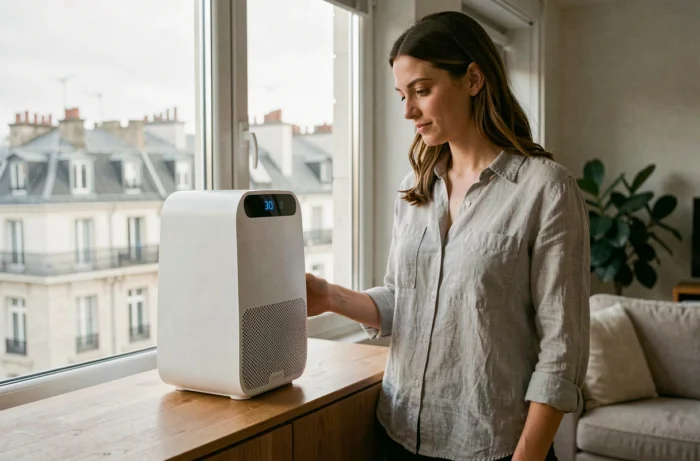
An air ionizer generates negative ions that attach to suspended particles (dust, pollen, spores) and weigh them down until they settle on surfaces. This simple mechanism explains both the benefits and limitations of these devices, especially in an apartment exposed to urban pollution.
Negative ions and surface deposition: what the ionizer really does to the air in an apartment
Unlike a HEPA filter purifier, the ionizer does not capture pollutants in a cartridge. It electrically charges them so they settle on furniture, walls, or textiles. In a downtown apartment, where fine particles from traffic enter through the windows, this distinction changes everything.
If no one regularly cleans the surfaces, the deposited particles can be re-suspended with the slightest draft or movement. The air may seem cleaner, but the pollutant load remains in the room. A fine filter vacuum cleaner and frequent damp wiping then become necessary to gain a real benefit from ionization.
This limitation does not render the ionizer useless. It requires considering it as a complement to a cleaning routine and proper ventilation, rather than as a standalone solution. This is precisely what the Ionizers guide for city apartments details by comparing several configurations suitable for small urban dwellings.
Ozone and chemical by-products: the real safety criterion for an air ionizer
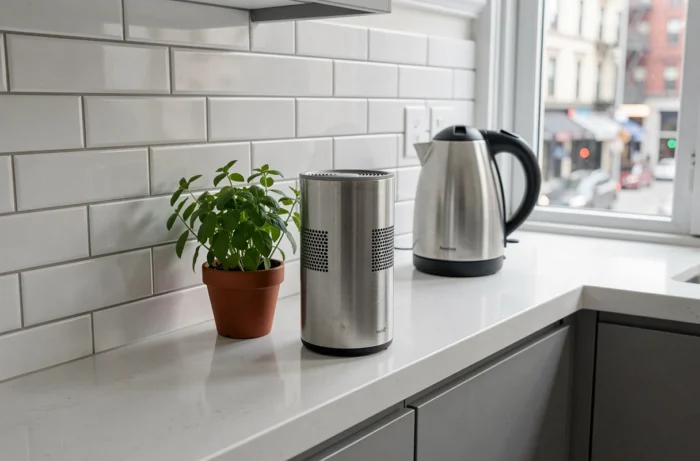
The issue of ozone deserves more than a glance at the packaging. Many manufacturers claim “ozone-free,” but this assertion is not always backed by independent testing.
Why the “ozone-free” label is not enough
ANSES reports that some active technologies (ozonation, plasma, photocatalysis) can generate by-products potentially more harmful than the pollutants being treated. Eliminating an odor does not mean eliminating pollution. In a poorly ventilated apartment, these secondary compounds accumulate.
A reliable benchmark for checking the safety of a device is the California CARB certification. It is based on real emission tests and maintains a public list of compliant devices. Before purchasing, checking if the model is on this list provides a guarantee that simple marketing claims do not offer.
What to check before buying
- The presence of an independent test report on ozone emissions, not just a manufacturer’s statement
- Inclusion on the CARB list or an equivalent certification confirming emissions measured under real conditions
- The absence of combined technologies (plasma, photocatalysis) if the manufacturer does not document the by-products generated
Ventilation and CO₂: what the ionizer does not address in an urban dwelling
An ionizer acts on particles and, to some extent, on allergens and odors. It does not treat carbon dioxide. In a downtown apartment where windows often remain closed (noise, outdoor pollution), the CO₂ level rises without the ionizer making any difference.
No purifier or ionizer can replace mechanical ventilation or regular airing. The flow of fresh air remains the only way to expel CO₂ and renew oxygen. Installing an ionizer without ensuring that the dwelling has a functional mechanical ventilation system or an airing protocol is akin to treating a symptom while ignoring the main cause of indoor air degradation.
For an urban apartment, the most coherent combination pairs proper ventilation (even 10 minutes of window opening morning and evening) with a particle treatment device suitable for the area.
Surface area, airflow, and noise: the technical criteria for choosing an apartment ionizer
Sizing is the most often overlooked factor. An ionizer designed for a large room in a 25 m² studio will not be more effective, but it will likely be noisier and more energy-consuming.
Match capacity to actual surface area
Each device covers a maximum area indicated by the manufacturer. For a city apartment, where rooms rarely exceed 20 to 30 m², a compact model is usually sufficient. The parameter to consider is the CADR (Clean Air Delivery Rate), which measures the volume of air treated per unit of time. The smaller the room, the lower the required CADR.
Noise, a decisive criterion in an apartment
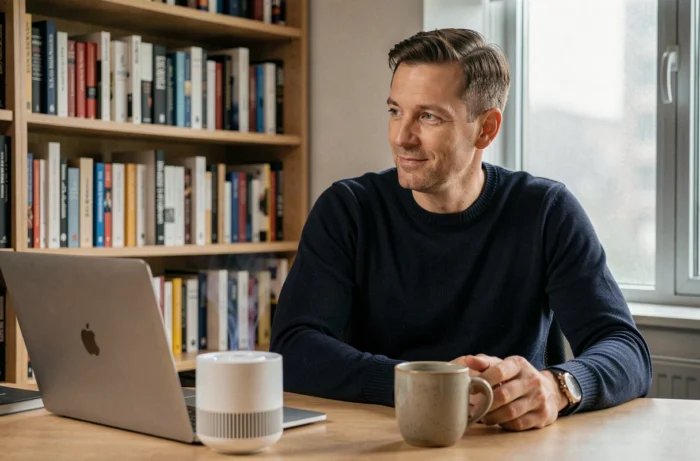
In the city, internal calm compensates for external noise. An ionizer operating at night in a bedroom must remain below a comfortable noise threshold. Pure ionization models (without a fan) are naturally silent, sometimes completely inaudible. Hybrid devices (ionizer + HEPA filter with fan) offer better particle capture but generate a constant airflow.
- Pure ionizer (without fan): silent, suitable for bedrooms, but requires frequent cleaning of surfaces
- Hybrid ionizer with HEPA filter: captures particles instead of depositing them, but produces noise and requires regular filter replacement
- Ionizer with integrated sensors: automatically adjusts intensity according to detected air quality, useful for limiting consumption and noise in standby mode
The choice between these configurations depends on the priority: absolute silence or maximum pollutant capture. In a studio or one-bedroom apartment, a well-maintained pure ionizer combined with regular airing covers most needs. For a through apartment exposed to a busy road, the hybrid with HEPA filter further limits the redeposition of fine particles on surfaces.
The last point to keep in mind is maintenance. A saturated HEPA filter loses its effectiveness and can become a breeding ground for bacteria. An ionizer without a filter, on the other hand, requires methodical dusting of the dwelling. In both cases, the device alone does not do the job.