A sofa that you no longer dare to move because the room only works in this configuration, a hallway too dark where shoes pile up, a living room that also serves as an office and playroom: we often start from these concrete irritants to rethink our interior. Transforming a space with style does not necessarily require major renovations, but rather some precise decisions about materials, volumes, and light.
Modular furniture: the answer to rooms that change function
When the living room becomes an office during the day and a guest bedroom on weekends, a fixed layout becomes restrictive within a few months. It is observed that decoration professionals are increasingly directing their recommendations towards modular furniture and multifunctional spaces. The logic is simple: instead of buying a piece of furniture for each use, we choose elements that can be combined or folded away.
An extendable solid oak table can accommodate four to eight diners without taking up space on a daily basis. A convertible sofa with an integrated storage compartment absorbs the extra bedding. These choices are particularly relevant in urban housing where spaces are shrinking and intergenerational cohabitation is becoming common.
Opinions vary on this point, but it is noted that a well-chosen modular piece of furniture ages better than a low-quality fixed piece. It is better to invest in a versatile centerpiece than to spread the budget across several pieces that won’t last. This approach can be found in the home section of Monsieur Magazine, which regularly details selections of furniture designed for multiple uses.
Reuse of materials: transforming your interior with what already exists
Reuse is no longer just an aesthetic argument to give a “reclaimed” feel to a room. It has become an operational subject, with structured channels. The feedback published by ADEME as part of the “Le Réemp'” program shows that the reuse of materials relies on operations of removal, sorting, and storage involving project owners, companies, and specialized design offices.
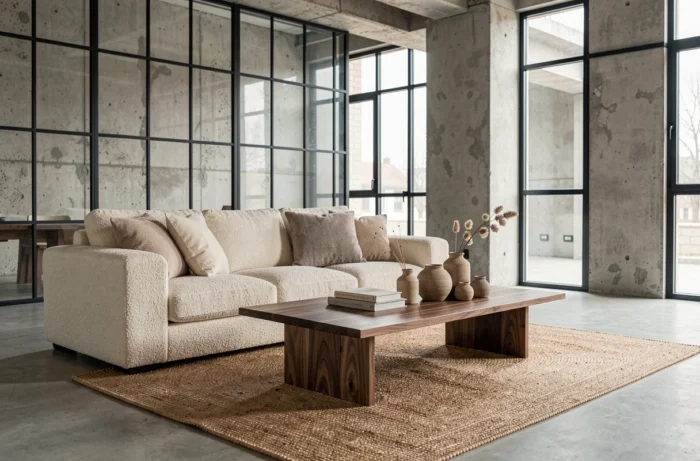
In practical terms, one can recover cement tiles, beams, old floorboards, or carpentry elements to integrate them into an interior decoration project. The main constraint remains the reimplementation: old floorboards must be recalibrated, sanded, and sometimes treated against wood-eating insects before being reinstalled.
Precautions before integrating reused materials
- Check the dimensional compatibility with the intended space, as old formats do not always match current standards
- Ensure the absence of harmful substances (lead in old paints, asbestos in certain floor coverings)
- Plan for additional labor costs for the preparation and adaptation of materials, even if the material itself is cheaper than new
The result brings a character that new materials struggle to replicate. A floor made of reclaimed tiles provides a visual depth that is impossible to imitate with industrial tiles.
Textiles and finishes: the impact of reduced chemical treatments
We don’t always think about it, but curtains, rugs, cushions, and sofa covers contribute as much to the atmosphere of a room as the wall color. However, the upholstery textile sector is undergoing a discreet transformation: the increased regulation of PFAS (per- and polyfluoroalkyl substances), used for stain-resistant and waterproof treatments, is prompting manufacturers to rethink their finishes.
For the transformation of an interior, this translates into a more careful selection of materials. Favoring raw linen, untreated cotton, or natural wool reduces exposure to persistent substances while providing a richer texture. A washed linen curtain does not fall like a treated polyester curtain: the drape is softer, and the filtered light is gentler.
How to choose your decorative textiles
Looking at the composition on the label is not enough. One should also consider the information provided by the manufacturer about the treatments applied. A cushion labeled “cotton” may have received a stain-resistant treatment based on PFAS. Requesting a technical sheet or buying from brands that communicate about the absence of these treatments is part of the process.
In terms of colors, there is no need to stick to neutral shades. A bold-colored textile (terracotta, deep blue, sage green) placed on simple furniture structures the space as much as a wall paint, with the advantage of being easily changeable.
Light and volumes: layering lighting in a living room
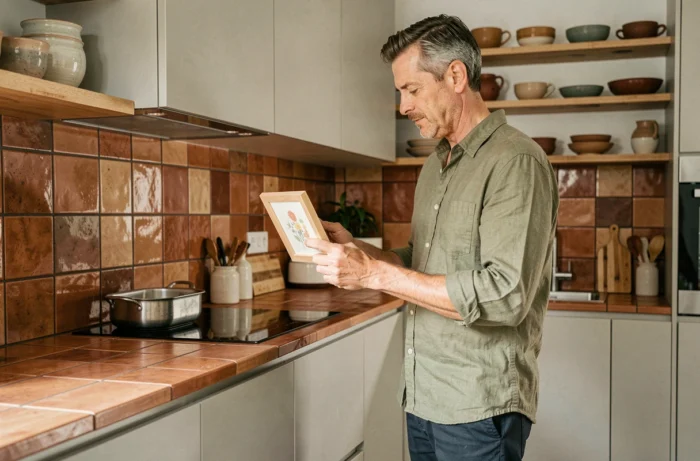
A central ceiling light that evenly illuminates the entire room flattens the volumes and strains the eyes. The most effective approach to give style to a living room is to layer multiple light sources at different heights: a swivel floor lamp near the sofa, a low hanging light above the table, wall sconces to outline the room’s contours.
Each source serves a purpose. Ambient light (pendant, garland) creates the overall atmosphere. Functional light (desk lamp, reading light) accompanies an activity. Accent light (spotlight, candle) highlights an object, a painting, or a niche.
- For a standard-sized living room, three to four sources are sufficient to create an elegant atmosphere without overloading the electrical plan
- Warm temperature bulbs (around 2700 K) remain the most comfortable choice for living spaces
- A dimmer on the main source allows for adjusting the intensity according to the time of day, which radically changes the feel of the room
Good lighting transforms a space more than any piece of furniture. You can have the most beautiful furniture in the world: if the lighting is poorly designed, the room remains flat.
Transforming your interior with style relies less on a substantial budget than on concrete choices, piece by piece. A modular piece of furniture that serves three purposes, an old floor carefully reinstalled, textiles chosen for their actual material, and layered lighting produce a more durable result than a purely cosmetic overhaul. The most effective approach is often to start with the room that irritates you the most on a daily basis.