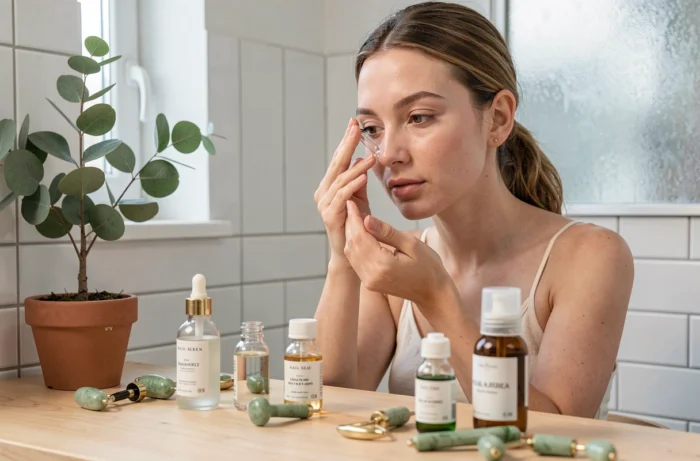
Skin reacts to what we apply to it, but also to what we don’t know about the ingredients in our products. Since January 1, 2026, French Law No. 2025-188 has prohibited the manufacture, import and sale of cosmetics containing PFAS above specified residual limits. This restriction is reshaping the beauty products available in France and encouraging people to rethink their routines and pay closer attention to labels.
Fragrance allergens and labeling: what’s changing when choosing your skincare
Have you ever experienced irritation after applying a cream without knowing what caused it? The answer is often in the INCI list, the long list of ingredients on the back of the product.
Fragrance allergen labeling is changing across the European Union. The number of substances that must be declared is increasing, making ingredient lists more detailed. For people with sensitive skin or a history of reacting to fragrance, this change offers a practical way to help prevent reactions.
In practice, this means that a “fragrance-free” product and one with “declared fragrance” are not the same. The first excludes fragrance molecules; the second lists them. Checking the INCI list before buying offers better protection than relying on a marketing label. A useful resource for keeping up with changes in the cosmetics market: https://www.beauty-inc.net.
Here are some habits to adopt when choosing a fragranced product:
- Look for the terms “fragrance” or “parfum” in the INCI list, which can conceal a blend of molecules that are not individually identified
- Check for named allergens (linalool, limonene, citronellol) and compare them with any reactions you’ve had in the past
- Choose formulas with clearly identified plant-derived fragrance ingredients, as their composition is more predictable
Daily sun protection: an essential part of your beauty routine
Many people still associate sunscreen with summer holidays. That’s a mistake. UV rays reach the skin all year round, even on cloudy days, and accelerate skin aging long before sunburn appears.
Pharmacy sales of sun protection products in France rose sharply in the first half of 2025 compared with the same period in 2024, according to GERS data reported by Revue Pharma. This figure reflects growing awareness: daily sun protection is the most research-backed anti-aging step in dermatology.
Why choose a daily sunscreen instead of a tinted moisturizer with SPF? It comes down to how much you apply. An SPF 30 foundation only protects if you apply a thick layer, which nobody does. A dedicated sunscreen, applied as the final step in your routine, provides real coverage.
Choosing a sunscreen filter that works with your routine
Mineral filters (zinc oxide, titanium dioxide) can sometimes leave a white cast on darker skin. Chemical filters absorb more readily into the skin but work better under makeup. Testing the texture on the back of your hand before buying helps avoid unpleasant surprises.
A good rule of thumb: apply two finger-lengths of product to your face and neck. Use less than that, and you won’t get the level of protection stated on the packaging.
Regulated ingredients and microplastics: streamlining your beauty routine
European rules on microplastics are being phased in according to the type of cosmetic product. The problem is that these ingredients aren’t always easy to identify in an INCI list: their names alone don’t always make it clear whether they fall under the regulatory definition.
In practice, synthetic polymer particles can be found in scrubs, toothpastes, some foundations and even shampoos. An exfoliant with “microbeads” is the most obvious example, but it’s not the only product affected.
With the ban on PFAS in cosmetics in France, another family of substances is gradually disappearing from formulations. PFAS were used to improve product wear (long-lasting lipsticks, waterproof foundations). Brands are reformulating, so textures may change slightly—and that’s normal.
Adjusting your routine without throwing everything away
There’s no need to clear out your bathroom cabinet overnight. The most sensible approach is to replace each product with a compliant version when it runs out.
- Start with rinse-off products (shower gels, shampoos, scrubs), which are among the first to be affected by microplastic restrictions
- Check long-wear foundations and lipsticks, which are more likely to contain PFAS
- For moisturizers, choose formulas based on plant oils (jojoba, argan, plant-derived squalane) with simple, easy-to-understand ingredients

Natural beauty routine: combining products that work well together
A strong market trend encourages people to add more and more steps: double cleansing, serum, essence, ampoule, cream, oil. For most skin types, three to four carefully chosen products are enough for a complete routine.
Cleansing is still the foundation. A gentle cleanser without harsh sulfates helps preserve the skin’s moisture barrier. Next comes a moisturizer suited to your skin type. In the morning, add sunscreen. In the evening, a targeted serum (vitamin C for radiance, niacinamide for pores, hyaluronic acid for hydration) completes your routine.
What matters more than the number of steps is how well the active ingredients work together. Retinol and vitamin C, for example, are rarely used in the same routine because they can cause irritation when combined. Alternating potent active ingredients between morning and evening reduces the risk of irritation.
Natural-looking radiance isn’t just a superficial cosmetic result. It reflects a healthy skin barrier, adequate hydration and controlled UV exposure. Far from making life harder for consumers, the new European regulations make it easier to distinguish reliable formulas from those based on ingredients now considered problematic. Every time a product runs out, you have an opportunity to make a more informed choice for its replacement.