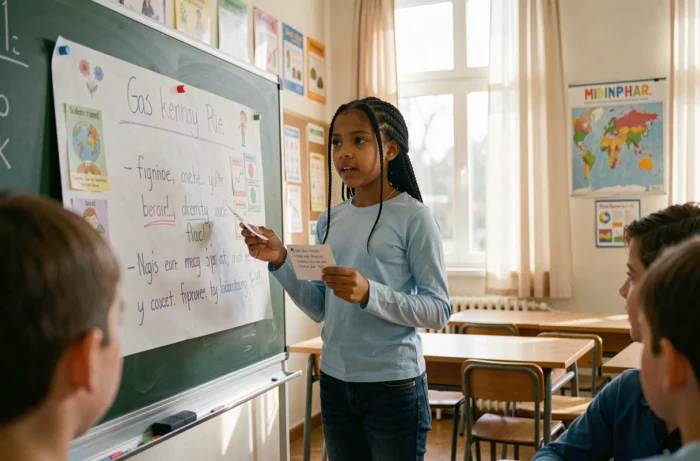
A CM1 presentation is a prepared oral exercise included in the French curriculum for Cycle 3. The Official Bulletin of April 17, 2025, asks pupils in the middle years of primary school to present information clearly and in a logical order, using their voice and body language to make themselves heard.
Choosing a presentation topic means finding a subject the child can research, check information about, and then explain to the class in their own words. The five ideas below were selected because each helps pupils develop a specific skill: citing a source, comparing information, or explaining a phenomenon without reciting copied text.
1. The water cycle in nature and in the city
This topic connects science to everyday life. The pupil can explain evaporation, condensation, and precipitation, then show how water reaches the tap. The vocabulary is accessible, and diagrams to draw or print make the presentation visual.
The main advantage of this topic: each stage of the cycle can be checked in a science textbook. The child learns to identify the type and source of a document, for example, “diagram from the science textbook, page 42.” This is exactly what the Cycle 3 curriculum expects in terms of research skills.
For the oral presentation, asking the pupil to draw a small diagram on the board during the talk encourages them to speak without reading their notes, since they explain what they are drawing. It’s a good way to practise speaking in front of others without reciting.
2. Everyday life in the Middle Ages
History is one of the most popular subjects in CM1, and the Middle Ages offers plenty of concrete material. Rather than covering ten centuries, it’s better to focus on one specific aspect: food, housing, or jobs in a medieval village. To find more ideas suited to this level, see a presentation topic for CM1 for different approaches.
Focusing on one specific angle prevents the presentation from going off topic and makes it more engaging. A pupil describing what a peasant ate in the 13th century is more likely to hold the audience’s attention than one giving a general summary copied from an encyclopedia.
This topic also provides an opportunity to introduce the idea of a historical source. The child can show an illuminated manuscript or an engraving and explain to the class where the image came from and which book or website they found it on. Keeping a short list of the documents consulted and presenting it at the end of the talk helps pupils develop the habit of tracking their sources.

3. An endangered animal and its natural habitat
Presenting an animal at risk of extinction (the Iberian lynx, pangolin, or axolotl) means explaining an ecosystem. The pupil describes the animal, its habitat, the threats it faces, and the conservation measures in place.
This topic is well suited to checking information. Institutional websites (national parks, natural history museums) publish fact sheets that a nine-year-old can understand. The pupil can compare two sources and point out if a figure differs from one document to another, providing an introduction to critical reading.
- Choose an animal with at least two reliable sources available (a nonfiction book, a national park website, or a museum website) so the information can be cross-checked.
- Prepare a visual fact file about the animal (size, diet, geographic range) to display during the presentation.
- End with a personal comment: what the pupil discovered and what surprised them, expressed in their own words.
4. Volcanoes: effusive and explosive eruptions
Volcanoes fascinate pupils and are part of the Cycle 3 science curriculum. The difference between an effusive eruption (a flow of runny lava) and an explosive eruption (a pyroclastic flow and ejected material) gives the presentation a natural structure: two sections, two mechanisms, and two examples.
Comparing two phenomena requires pupils to organize their ideas, which directly matches the curriculum’s expectation that information be presented in a logical order. A two-column chart displayed on the wall is all that’s needed as a visual aid.
For their research, the pupil can consult a children’s documentary and the website of a volcanological observatory. The curriculum distinguishes prepared speaking from spontaneous speaking: preparing this chart in advance and then discussing it in front of the class without reading everything is precisely this kind of structured oral exercise.
5. The invention of writing and its earliest forms
This topic combines history with reflection on communication. The pupil can show what Sumerian clay tablets, Egyptian hieroglyphs, and papyrus looked like, then explain why writing changed the way information was passed on.
There are two educational benefits. First, the pupil explains what they have learned in their own words instead of reciting a definition. Second, they can bring in a real object (a piece of clay or a sheet of papyrus bought from a bookshop) to make the presentation more tangible.
The ministerial framework issued in June 2025 provides for raising awareness of artificial intelligence in primary school, but not for pupils to use generative AI directly. For a topic like this, that means prioritizing sources the child can consult and understand independently: a book, an article in a children’s magazine, or a museum webpage. The presentation feels more authentic when the pupil can explain where they found each piece of information.
- Ask the child to note the title of the book or the website address for each fact they present.
- Encourage them to say “I read that…” or “According to the book…” rather than making claims without citing a source.
- Limit the text on the poster to a few keywords: a prepared oral presentation is based on notes, not on reading a full text aloud.
A successful CM1 presentation isn’t measured by how much information the pupil recites. What matters is their ability to say where their information comes from and explain it clearly. The five topics suggested here have one thing in common: each offers accessible, verifiable sources and is concrete enough for the child to speak in their own words rather than someone else’s.